Celebrating a Double Milestone: Congratulations to Professors Sonia Baelo-Allué and Mónica Calvo Pascual

We are delighted to share some wonderful news for the TYPH research group: our Principal Investigators, Prof. Sonia Baelo-Allué and Prof. Mónica Calvo Pascual, have both been promoted to Full Professor.

This is an outstanding and well-deserved recognition of their distinguished academic careers and their many contributions to research, teaching, and university life. Throughout the years, Sonia and Mónica have established themselves as leading scholars in their respective fields while also mentoring generations of students and early-career researchers with remarkable generosity and dedication.

As leaders of TYPH, they have played a fundamental role in developing an internationally recognised research community devoted to the study of posthumanities, contemporary literature, trauma studies, ecocriticism, and related interdisciplinary fields. Their vision, commitment, and collaborative spirit continue to inspire everyone in our group.

We are incredibly proud to celebrate this milestone with them and grateful for their continued leadership. We look forward to the many exciting projects, publications, conferences, and collaborations that lie ahead.

Congratulations, Sonia and Mónica, on this exceptional achievement. We wish you every success in this new stage of your academic careers!

Sergio Salvador Successfully Defends His PhD Thesis on Power and Inequality in Cyberpunk Fiction

We are delighted to announce that our team member Sergio Salvador has successfully defended his doctoral thesis, Wired for Inequality: Power and Privilege in the Cyberpunk Dystopia, supervised by María Ferrández San Miguel and Francisco Collado Rodríguez.

Sergio’s dissertation offers an in-depth examination of cyberpunk fiction as a critical lens through which to explore contemporary questions of power, inequality, technological development, and social privilege. By analyzing dystopian worlds shaped by advanced technologies, corporate domination, and widening social divides, his research demonstrates how cyberpunk narratives continue to provide valuable insights into the structures and tensions that characterize the twenty-first century.

Cyberpunk has long been one of the most influential subgenres of science fiction, imagining futures in which technological innovation coexists with social fragmentation and economic disparity. Sergio’s work investigates how these narratives challenge dominant assumptions about technological progress, revealing the ways in which systems of power and privilege are reproduced, transformed, and contested within speculative futures.

The successful defense of Wired for Inequality represents a significant contribution to the fields of science fiction studies, cultural studies, and contemporary literary criticism. More broadly, the thesis highlights the continuing relevance of speculative fiction as a space for reflecting on urgent social, political, and ethical concerns.

We warmly congratulate Dr. Sergio Salvador on this important achievement and thank María Ferrández San Miguel and Francisco Collado Rodríguez for their supervision and support throughout the project.

We look forward to following the next stages of Sergio’s academic career and the future development of his research.

Lucía Bennett Ortega Successfully Defends Her PhD Thesis

We are delighted to share that our team member Lucía Bennett Ortega has successfully defended her doctoral thesis, Posthuman Disabled Ontologies in Richard Powers’ Fiction, supervised by Dr. Miriam Fernández Santiago at the University of Granada.

This milestone marks the culmination of years of dedicated research supported by a highly competitive FPU fellowship awarded by the Spanish Ministry of Education. Lucía’s dissertation offers an innovative examination of disability, embodiment, and posthuman subjectivity in the fiction of contemporary American novelist Richard Powers, contributing to ongoing debates in critical posthumanism, disability studies, and literary criticism.

Lucía graduated in English Studies from the University of Granada in 2020, receiving the Extraordinary End-of-Degree Distinction. During her undergraduate studies, she was awarded a Departmental Collaborative Grant funded by the Spanish Ministry of Education. She subsequently completed a Master’s degree in English Literature and Linguistics before obtaining an FPU fellowship to pursue her doctoral research.

Throughout her academic career, Lucía has demonstrated an exceptional commitment to research and international collaboration. She has been a Visiting Scholar at the University of Glasgow and at the University of Illinois Chicago, where she carried out a six-month research stay funded by a Fulbright Scholarship.

Her research interests include critical posthumanism, disability studies, feminist criticism, and contemporary literature. Her work has appeared in prestigious journals, including English Studies, Alicante Journal of English Studies, and Atlantis. Since September 2024, she has also served as Young Scholars Coordinator of the Spanish Association of American Studies (SAAS), contributing to the development of emerging scholars in the field.

Lucía’s successful defense represents not only a remarkable personal achievement but also an important contribution to the growing body of scholarship exploring the intersections of literature, disability, and posthuman theory.

We warmly congratulate Dr. Lucía Bennett Ortega on this outstanding accomplishment and wish her every success in the next stage of her academic career.

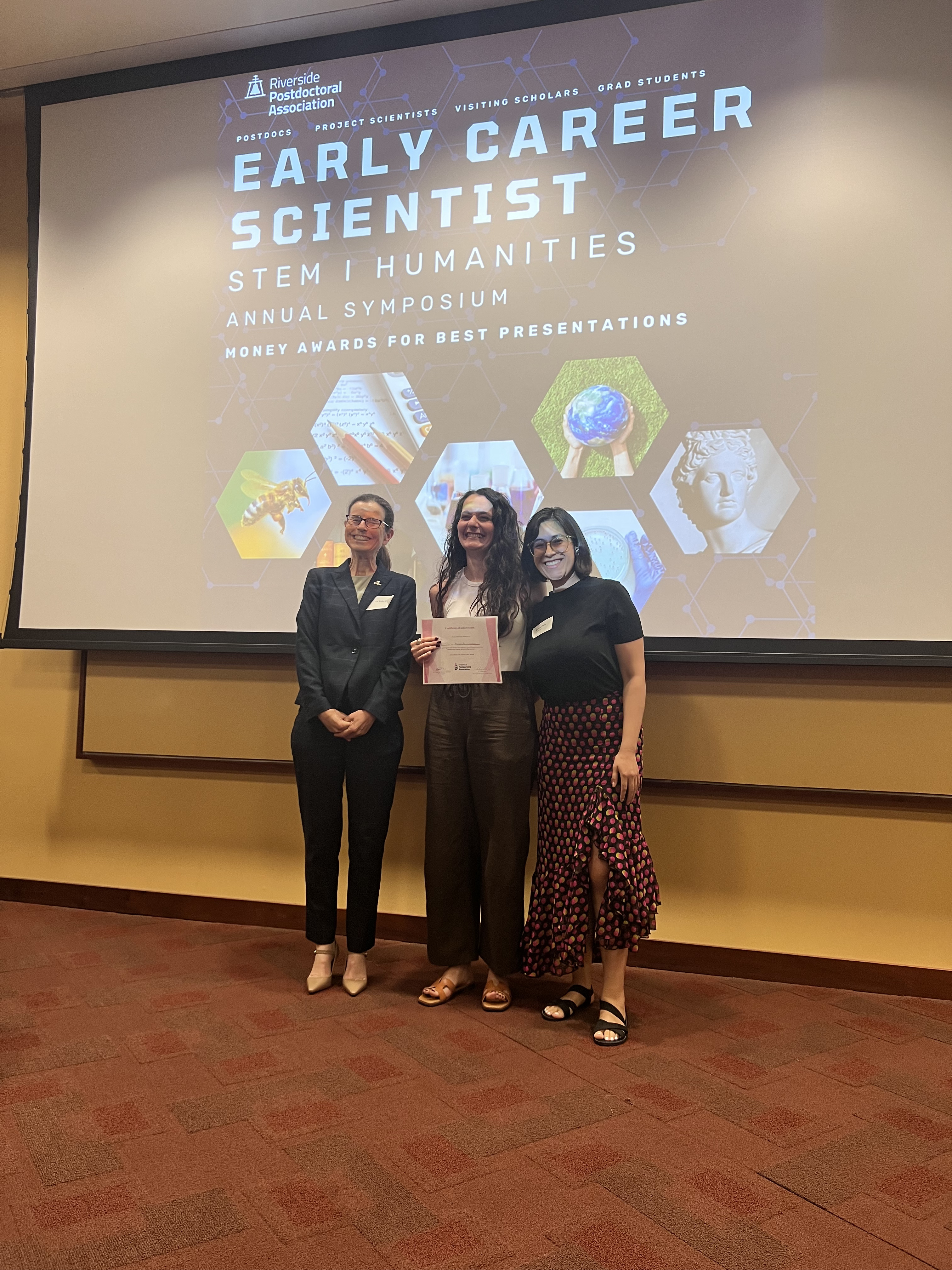
María Abizanda Cardona Receives First Prize at UC Riverside Early Career Scientist Symposium

We are delighted to share that our team member María Abizanda Cardona has been awarded First Prize for Oral Presentations at the 2026 Early Career Scientist Symposium, organized by the Postdoctoral Association at the University of California, Riverside.

The symposium brought together researchers from a wide range of disciplines, providing an opportunity for early-career scholars to present their work, exchange ideas, and build new interdisciplinary connections. María’s presentation, titled “Why Scientists Should Read Crime Fiction: Literature as a Laboratory for Scientific Ethics,” explored how literary narratives can serve as valuable tools for reflecting on ethical questions in science and technology.

Her research demonstrates how crime fiction can function as a space for examining complex issues such as scientific responsibility, emerging technologies, and the social consequences of innovation. By bringing together literary studies and scientific ethics, the project highlights the important contributions that the humanities can make to contemporary debates about science and society.

Receiving the symposium’s top award is a significant achievement and a recognition of both the originality and relevance of María’s research. It also reflects the growing importance of interdisciplinary approaches that bridge the humanities, social sciences, and STEM fields.

In addition to presenting her work, María described the symposium as a valuable opportunity to meet fellow researchers, learn about projects across disciplines, and strengthen connections within the academic community.

We warmly congratulate María on this well-deserved recognition and look forward to following the continued development of her research.

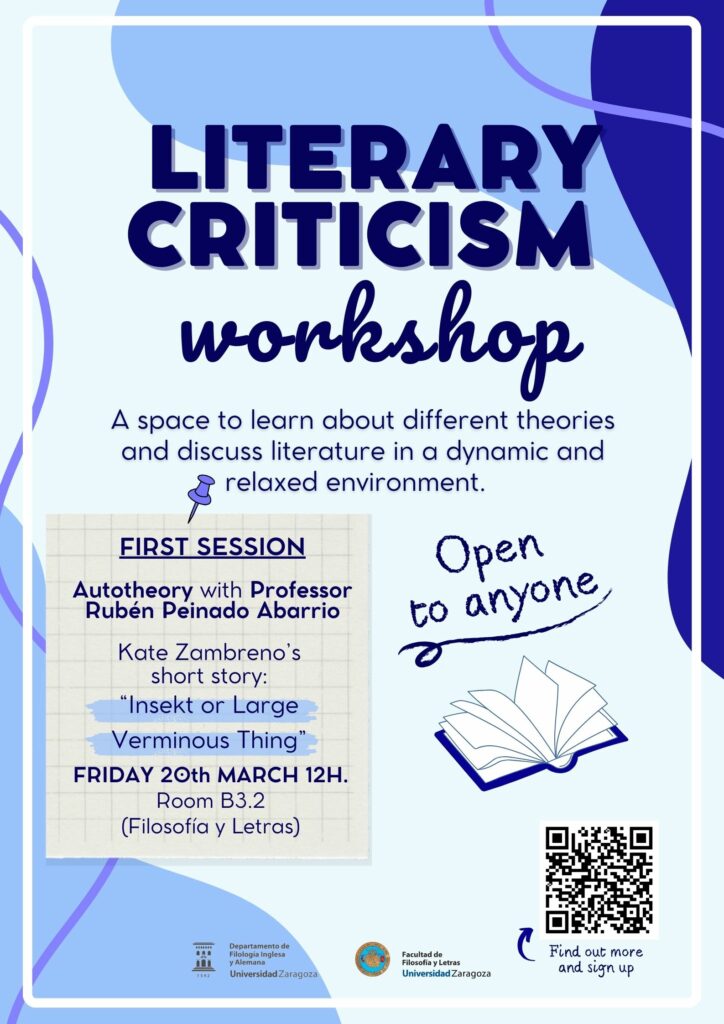
New Session of the Literary Criticism Workshop

A new session of the Literary Criticism Workshop will take place on Friday, 20 March at 12:00 in Room B3.2 at the Facultad de Filosofía y Letras, Universidad de Zaragoza.

The session, titled “Autotheory and Kate Zambreno’s short story: Insekt or Large Verminous Thing,” will be led by Rubén Peinado Abarrio.

This workshop series provides a collaborative space where students and researchers can engage with different approaches to literary theory and criticism through the discussion of specific texts. In this session, participants will explore the concept of autotheory through the work of contemporary writer and critic Kate Zambreno, whose experimental writing often blurs the boundaries between literary criticism, personal narrative, and creative practice.

The discussion will focus on Zambreno’s short story Insekt or Large Verminous Thing, examining how autotheoretical writing challenges conventional distinctions between scholarship and personal reflection while opening new possibilities for literary analysis.

The Literary Criticism Workshop aims to foster a dynamic and welcoming environment for discussing literature and critical theory.

📍 Location: Room B3.2, Facultad de Filosofía y Letras
🗓 Date: Friday, 20 March 2026
Time: 12:00

The session is open to anyone interested in literature and literary criticism. 📖✨

Call for Papers: Unbound, Unfinished, Ongoing: A Kate Zambreno Symposium

We are pleased to share a Call for Papers for the symposium Unbound, Unfinished, Ongoing: A Kate Zambreno Symposium, a one-day online event dedicated to the work of Kate Zambreno, one of the most distinctive voices in contemporary experimental writing and literary criticism.

The symposium will take place online on 23 October 2026 and is hosted by the Complutense University of Madrid and the University of Zaragoza. The event is organized by literary scholar Rubén Peinado, a member of our research team.

Zambreno’s work—spanning fiction, autofiction, literary criticism, and hybrid writing—has played a significant role in reshaping contemporary discussions around authorship, archives, feminist criticism, and the boundaries between life writing and literary scholarship. This symposium seeks to bring together scholars working on Zambreno’s oeuvre as well as those interested in the broader questions her work raises about contemporary literary culture.

We welcome proposals that engage with topics such as:

  • Autofiction and hybrid literary forms
  • Feminist criticism and experimental writing
  • Archives, fragments, and literary memory
  • Contemporary literary criticism and creative practice
  • The intersections between scholarship and creative writing

Researchers from a wide range of disciplines within literary and cultural studies are encouraged to submit proposals.

🗓 Abstract deadline: 1 July 2026
📅 Symposium date: 23 October 2026
💻 Format: Online

For the full Call for Papers and submission guidelines, please visit:
https://sites.google.com/view/kate-zambreno-symposium/inicio

We warmly encourage colleagues and researchers interested in contemporary experimental literature, feminist criticism, and hybrid writing to consider submitting a proposal and to share this call with their networks.

New profile on ResearchGate!

We’re thrilled to share that you can now visit The Posthuman Wound Research Team on ResearchGate 👩‍🔬📚✨

Discover our latest publications, explore ongoing projects, and meet the researchers behind our work on posthumanism, crime fiction, and 21st-century literature 🖋️🔬📖.

Stay connected with us and follow our journey here 👉 https://www.researchgate.net/lab/The-Posthuman-Wound-Research-Team-Sonia-Baelo-Allue 🌐💡

The Posthuman Wound is now on Instagram!

We have exciting news… our research group now has an official Instagram account! 🎉📸

Why follow us? Because we’re bringing posthumanism, literature, and research closer to you in a fun and dynamic way. Expect:

  • 🔬 Research updates – See what our team is working on, from cutting-edge projects to international collaborations.
  • 🎙️ Podcasts and videos– Dive into conversations about American literature, posthumanism, and contemporary culture.
  • Events and conferences
  • 📚 Publications and resources – Discover our latest open-access articles, books, and innovative research projects..

Keynote “Literature(s) in English (I): Imaginative Encounters”

Our team member Miriam Fernández Santiago will be delivering the keynote “The Neo-Apollonian: A Posthumanist Sign of the Digital Times” next Wednesday as part of the cycle of conferences Literature(s) in English (I): Imaginative Encounters.

Literature(s) in English (I): Imaginative Encounters is a seminar organized by the Master in Advanced English Studies at the University of Salamanca and the University of Valladolid. It brings together experts from several international universities working on different periods of English and American literature.

The Literature(s) in English (I) seminar will be mostly held online, via Zoom. Anyone who wishes to attend the seminar is expected to register, using the following link.