Welcome to the website of the research projects «The Posthuman Wound: Subject and Agency in the North American Literature of the 21st Century» (PID2022-137627NB-I00. 2023-2026), «Contemporary North American Fiction and the 4th Industrial Revolution: From Posthumanity to Privation and Social Change» (PID2019-106855GB-I00. 2020-2023) and «Trauma, Culture and Posthumanity: The Definition of Being in Contemporary American fiction» (FFI2015-63506-P. 2016-2020).
Nos complace anunciar que nuestra investigadora predoctoral María Abizanda Cardona participó ayer en la semifinal del concurso Tesis en 3 Minutos (T3M 2026), organizado por Campus Iberus.
Durante su intervención, María expuso las líneas principales de su tesis doctoral en una presentación concisa y adaptada a la divulgación científica. Tras la deliberación del jurado, nos alegra enormemente comunicar que se ha clasificado para la fase final del certamen, la cual se celebrará en Logroño el próximo 6 de noviembre de 2026.
El concurso Tesis en 3 Minutos (T3M) plantea el reto a los investigadores e investigadoras de doctorado de comunicar la trascendencia e impacto de sus tesis en un tiempo máximo de tres minutos, empleando un lenguaje claro y accesible para la sociedad.
Desde el grupo de investigación TYPH, felicitamos calurosamente a María por este magnífico logro y por su constante labor de transferencia del conocimiento. ¡Le deseamos el mayor de los éxitos en la final de Logroño! 🎓🏆✨
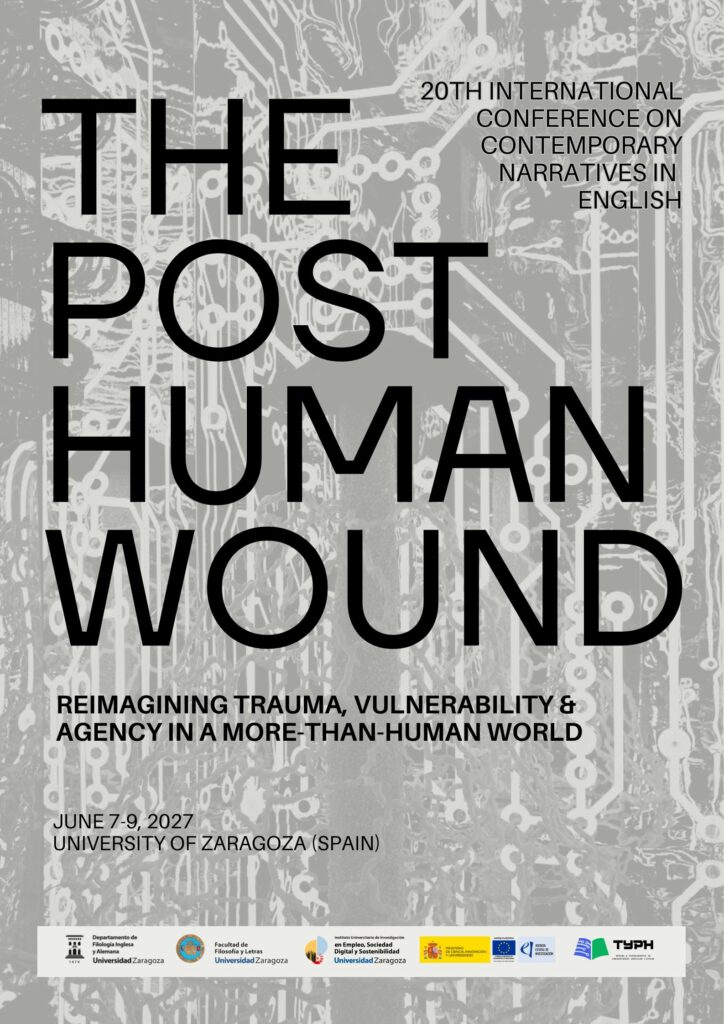
The research group The Posthuman Wound, from the Department of English and German Philology at the University of Zaragoza, is pleased to announce the Call for Papers for the 20th International Conference on Contemporary Narratives in English, entitled:
The Posthuman Wound: Reimagining Trauma, Vulnerability, and Agency in a More-than-Human World
The conference will take place at the University of Zaragoza (Spain) from 7 to 9 June 2027 and will bring together scholars working across contemporary literature, cultural studies, film and television, digital media, and related fields.
Rethinking trauma and vulnerability in a posthuman world
Since the beginning of the twenty-first century, trauma has become an increasingly important framework for understanding contemporary subjectivity, identity, rupture, violence, and loss. At the same time, the rapid transformation of our world through digital technologies, ecological crisis, biotechnology, artificial intelligence, and increasingly interconnected infrastructures has contributed to what has been described as a posthuman turn, challenging traditional assumptions about human autonomy, exceptionalism, and self-sufficiency.
Although trauma studies and critical posthumanism have developed along different trajectories, both fields share a concern with subjectivity, embodiment, agency, vulnerability, relationality, and the boundaries of the human. The concept of the posthuman wound emerges from this convergence.
The conference invites us to think about vulnerability not simply as injury or deficiency, but as a constitutive feature of embodied and relational existence. In an increasingly technological and ecologically entangled world, our memories, identities, bodies, and forms of agency are distributed across biological, technological, social, and environmental assemblages. These transformations generate new forms of exposure and vulnerability, but they may also open up new possibilities for ethical responsibility, collective care, and more-than-human forms of agency.
Against this background, the conference asks how contemporary narratives represent and reimagine trauma, vulnerability, and agency in a world where the human is increasingly understood as relational, embodied, interconnected, and embedded within more-than-human assemblages.
Areas of interest
We welcome contributions examining contemporary literature alongside film, television, digital media, and other cultural forms. We particularly welcome papers engaging with the intersections between trauma studies, critical posthumanism, environmental humanities, new materialisms, critical animal studies, media studies, disability studies, and related fields.
Possible topics include, but are not limited to:
Dialogues between trauma studies, critical posthumanism, and vulnerability studies.
Narratives of vulnerability, precarity, and resilience in the posthuman condition.
Aesthetic, formal, and narratological approaches to trauma and the posthuman, non-human, and more-than-human.
Digital vulnerability, including artificial intelligence, algorithmic cultures, technoscience, surveillance, automation, and datafication.
The Anthropocene, climate fiction, and environmental humanities, including ecoanxiety, solastalgia, ecological grief, and planetary precarity.
Transhumanism, biotechnology, cyborg bodies, and technological transformations of identity.
New materialist and posthumanist approaches to matter, embodiment, and nonhuman agency.
Multispecies relations, critical animal studies, and more-than-human forms of kinship.
Disability studies, crip theory, and posthuman approaches to embodiment, vulnerability, and care.
Feminist, queer, and decolonial posthumanisms.
Trauma and the posthuman across genres, including science fiction, speculative fiction, crime fiction, horror, weird fiction, and climate fiction.
Posthuman narratives across media, including film, television, graphic narratives, videogames, interactive fiction, and digital storytelling.
Ethics, care, justice, and alternative futures, including death, mourning, extinction, repair, hope, and collective forms of flourishing.
Plenary speakers
The conference will feature three distinguished plenary speakers:
Marco Caracciolo — Ghent University
Ana María Fraile-Marcos — University of Salamanca
Mark Bould — University of the West of England, Bristol
Further information about the plenary speakers and the conference programme can be found on the conference website.
Submit your proposal
Paper presentations will be 20 minutes, followed by 10 minutes for questions and discussion.
Proposals should be no more than 300 words and should include:
Paper title
Author’s email address
Institutional affiliation
A bionote of no more than 100 words
Key dates
📩 Abstract submission deadline: 15 January 2027
📢 Notification of acceptance: February 2027
📍 Conference: 7–9 June 2027
Proposals should be submitted through the online submission form indicated on the conference website.
Join us in Zaragoza
With The Posthuman Wound, we hope to create a space for interdisciplinary dialogue around some of the most pressing questions facing contemporary culture: What does it mean to be vulnerable in a posthuman world? How are technological and ecological transformations reshaping our understanding of trauma and agency? And how can contemporary narratives help us imagine new forms of relationality, care, responsibility, and collective flourishing?
We look forward to receiving your contributions and to welcoming scholars working across different disciplines, media, genres, and theoretical approaches to Zaragoza in June 2027.
🔗 For the full Call for Papers, submission guidelines, information about the plenary speakers, venue, organizers, and all other conference details, please visit the official conference website:
¿Qué significa ser humano en un mundo en el que la tecnología transforma cada vez más nuestros cuerpos, nuestras capacidades y nuestra manera de relacionarnos con el entorno?
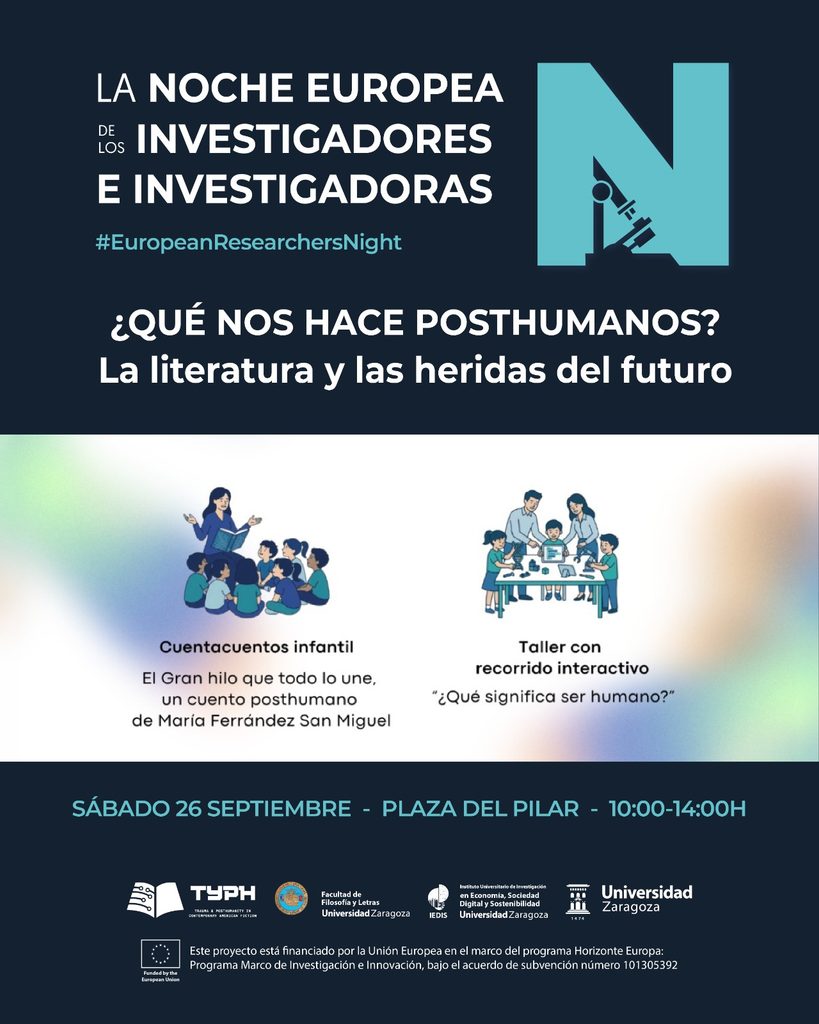
El próximo sábado 26 de septiembre, el grupo The Posthuman Wound participará en la Noche Europea de los Investigadores e Investigadoras 2026 con la actividad «¿Qué nos hace posthumanos? La literatura y las heridas del futuro», una propuesta dirigida a público familiar y general que combina literatura, divulgación y participación.
A través de diferentes actividades, invitaremos a las y los participantes a acercarse a algunas de las preguntas centrales del posthumanismo: ¿qué nos define como humanos?, ¿qué ocurre cuando la tecnología transforma nuestros cuerpos y nuestras capacidades?, ¿cómo podemos imaginar otros futuros?, ¿y qué nuevas formas de vulnerabilidad pueden surgir de nuestras relaciones con la tecnología?
Durante la mañana tendremos dos propuestas:
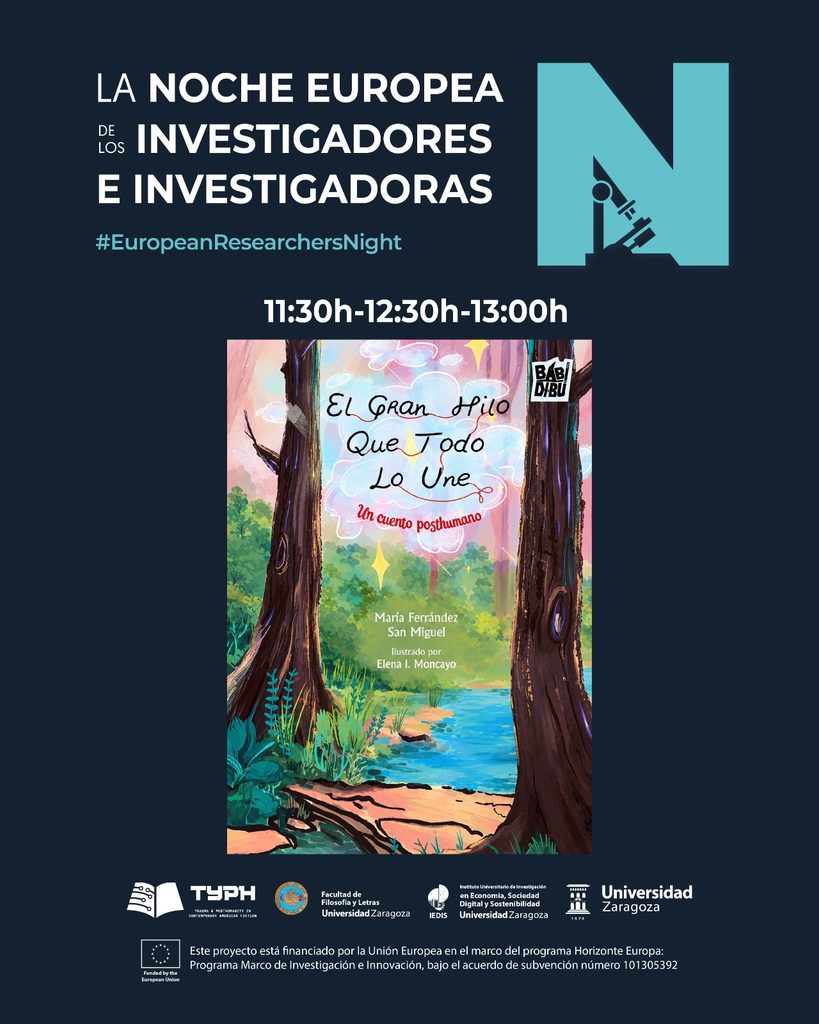
📖 Cuentacuentos infantil
El gran hilo que todo lo une, un cuento posthumano, de María Ferrández San Miguel
Una actividad especialmente pensada para público infantil que utiliza el cuento como punto de partida para explorar las conexiones entre humanos, naturaleza y tecnología y acercar algunas ideas del pensamiento posthumano de una manera accesible y participativa.
🔎 Taller con recorrido interactivo
¿Qué significa ser humano?
Una propuesta participativa para explorar diferentes dimensiones de lo humano y reflexionar sobre cómo la tecnología puede transformar nuestra manera de entender el cuerpo, la identidad, la inteligencia y nuestras relaciones con el mundo.
No se trata de ofrecer respuestas cerradas, sino de experimentar, imaginar y hacernos nuevas preguntas.
📍 Plaza del Pilar, Zaragoza 📅 Sábado 26 de septiembre de 2026 ⏰ 10:00–14:00 h 👨👩👧👦 Público familiar y general
La actividad forma parte de la Noche Europea de los Investigadores e Investigadoras 2026, bajo el lema «Ciencia en Aragón: Imagina el mañana», y está organizada por The Posthuman Wound, Universidad de Zaragoza.
Os esperamos para imaginar el mañana y preguntarnos qué nos hace —y qué podría llegar a hacernos— posthumanos.
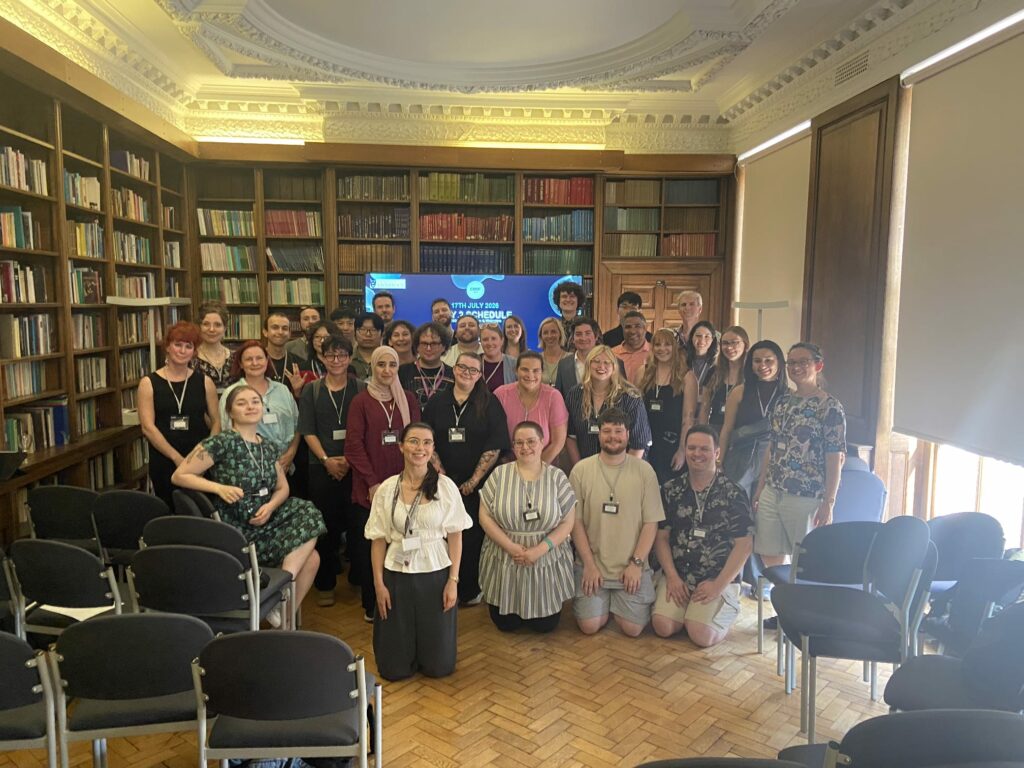
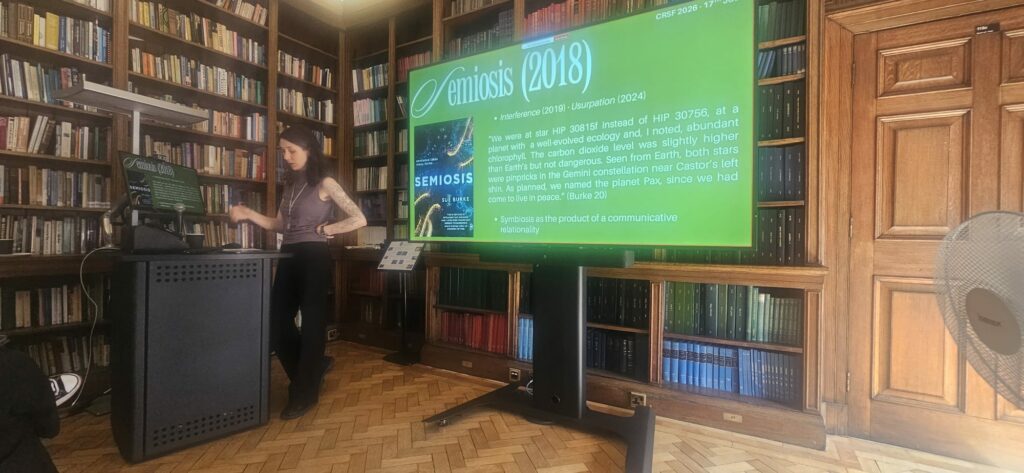
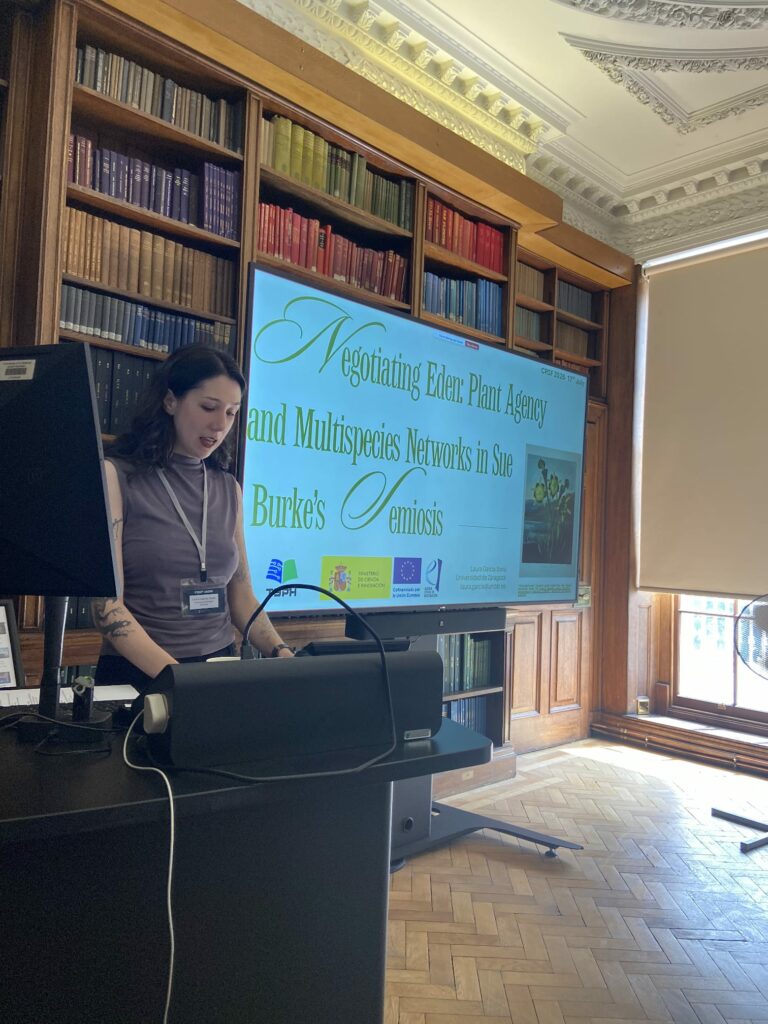
We are delighted to announce that our predoctoral researcher Laura García Soria participated in the Current Research in Speculative Fiction (CRSF) Conference 2026, hosted by the University of Liverpool from 16 to 17 July 2026.
Laura presented her paper, titled “Plant agency and multispecies networks in Sue Burke’s Semiosis,” which examines the complex portrayal of plant intelligence and the formation of multispecies alliances in contemporary science fiction. Her work contributes to the growing field of posthuman plant studies, exploring how speculative narratives challenge anthropocentric views of agency and relationality.
The CRSF conference is a key international forum for scholars working across all modes of speculative fiction. We warmly congratulate Laura on her successful presentation and for representing the TYPH research group in Liverpool! 🌿🎓
We are delighted to share some wonderful news for the TYPH research group: our Principal Investigators, Prof. Sonia Baelo-Allué and Prof. Mónica Calvo Pascual, have both been promoted to Full Professor.
This is an outstanding and well-deserved recognition of their distinguished academic careers and their many contributions to research, teaching, and university life. Throughout the years, Sonia and Mónica have established themselves as leading scholars in their respective fields while also mentoring generations of students and early-career researchers with remarkable generosity and dedication.
As leaders of TYPH, they have played a fundamental role in developing an internationally recognised research community devoted to the study of posthumanities, contemporary literature, trauma studies, ecocriticism, and related interdisciplinary fields. Their vision, commitment, and collaborative spirit continue to inspire everyone in our group.
We are incredibly proud to celebrate this milestone with them and grateful for their continued leadership. We look forward to the many exciting projects, publications, conferences, and collaborations that lie ahead.
Congratulations, Sonia and Mónica, on this exceptional achievement. We wish you every success in this new stage of your academic careers!
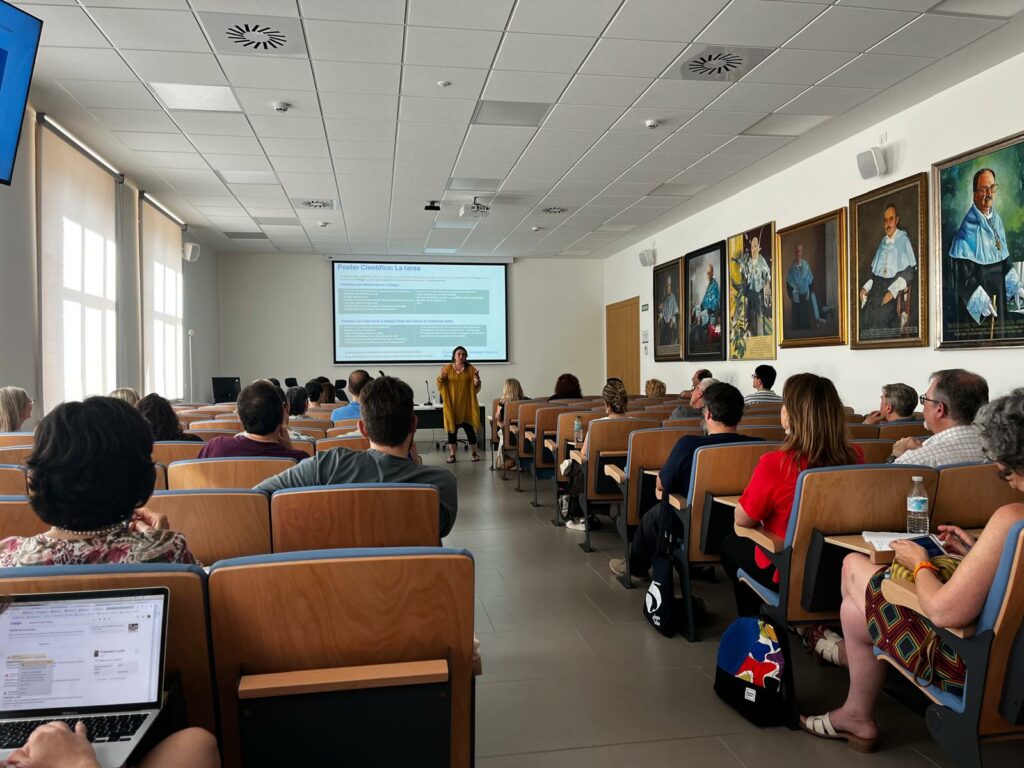
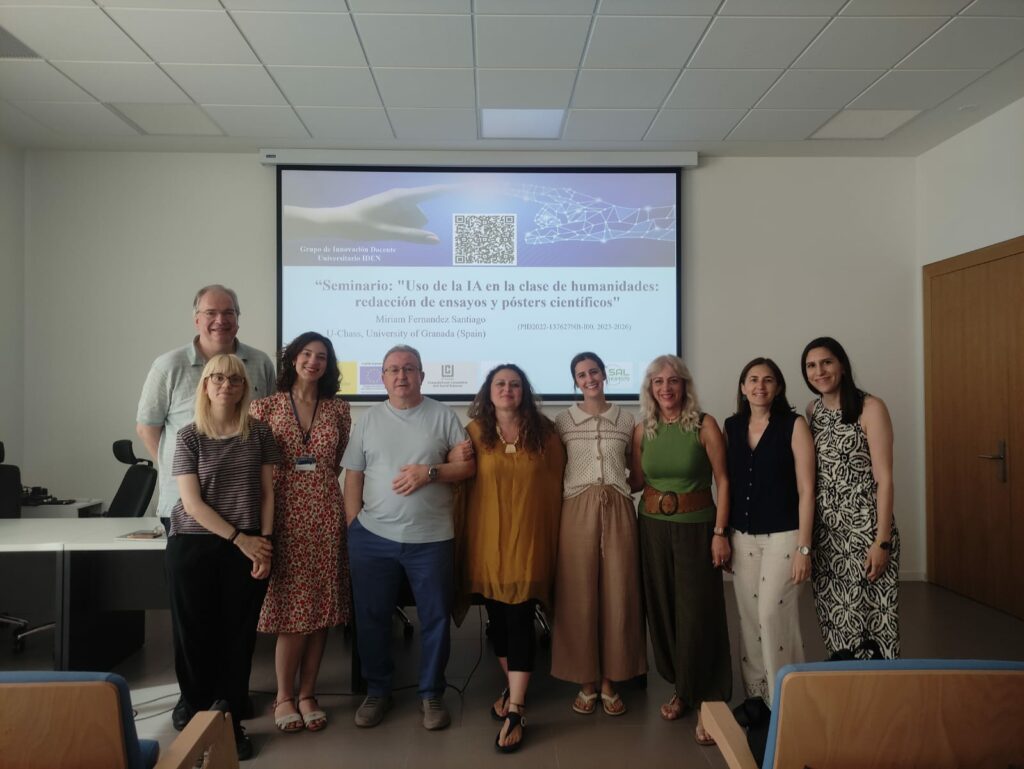
Today, members of TYPH’s Teaching Innovation Group (IDEN – Innovación y Docencia en Estudios de Literatura Norteamericana) held the seminar “Using AI in the Humanities Classroom: Writing Essays and Scientific Posters,” delivered by Dr. Miriam Fernández Santiago.
The seminar provided an opportunity to reflect on one of the most pressing challenges currently facing higher education: how to integrate artificial intelligence into teaching in ways that enhance learning while promoting critical thinking, academic integrity, and digital literacy. Through practical examples and discussion, participants explored how AI can support students in the preparation of essays and scientific posters, as well as the pedagogical opportunities and ethical questions these technologies raise.
We would like to express our sincere gratitude to Dr. Miriam Fernández Santiago for sharing her expertise with such generosity and enthusiasm. Her seminar sparked engaging conversations and offered valuable tools for colleagues interested in incorporating AI thoughtfully into their teaching practice.
We are also grateful to the Faculty of Philosophy and Letters of the University of Zaragoza for providing the venue, and to CIFICE for supporting this initiative. Finally, thank you to everyone who attended and contributed to the lively exchange of ideas.
Events such as this reflect TYPH’s ongoing commitment to promoting innovative, collaborative, and critically informed approaches to Humanities teaching and research.
We are delighted to announce that our team member Sergio Salvador has successfully defended his doctoral thesis, Wired for Inequality: Power and Privilege in the Cyberpunk Dystopia, supervised by María Ferrández San Miguel and Francisco Collado Rodríguez.
Sergio’s dissertation offers an in-depth examination of cyberpunk fiction as a critical lens through which to explore contemporary questions of power, inequality, technological development, and social privilege. By analyzing dystopian worlds shaped by advanced technologies, corporate domination, and widening social divides, his research demonstrates how cyberpunk narratives continue to provide valuable insights into the structures and tensions that characterize the twenty-first century.
Cyberpunk has long been one of the most influential subgenres of science fiction, imagining futures in which technological innovation coexists with social fragmentation and economic disparity. Sergio’s work investigates how these narratives challenge dominant assumptions about technological progress, revealing the ways in which systems of power and privilege are reproduced, transformed, and contested within speculative futures.
The successful defense of Wired for Inequality represents a significant contribution to the fields of science fiction studies, cultural studies, and contemporary literary criticism. More broadly, the thesis highlights the continuing relevance of speculative fiction as a space for reflecting on urgent social, political, and ethical concerns.
We warmly congratulate Dr. Sergio Salvador on this important achievement and thank María Ferrández San Miguel and Francisco Collado Rodríguez for their supervision and support throughout the project.
We look forward to following the next stages of Sergio’s academic career and the future development of his research.
We are delighted to share that our team member Lucía Bennett Ortega has successfully defended her doctoral thesis, Posthuman Disabled Ontologies in Richard Powers’ Fiction, supervised by Dr. Miriam Fernández Santiago at the University of Granada.
This milestone marks the culmination of years of dedicated research supported by a highly competitive FPU fellowship awarded by the Spanish Ministry of Education. Lucía’s dissertation offers an innovative examination of disability, embodiment, and posthuman subjectivity in the fiction of contemporary American novelist Richard Powers, contributing to ongoing debates in critical posthumanism, disability studies, and literary criticism.
Lucía graduated in English Studies from the University of Granada in 2020, receiving the Extraordinary End-of-Degree Distinction. During her undergraduate studies, she was awarded a Departmental Collaborative Grant funded by the Spanish Ministry of Education. She subsequently completed a Master’s degree in English Literature and Linguistics before obtaining an FPU fellowship to pursue her doctoral research.
Throughout her academic career, Lucía has demonstrated an exceptional commitment to research and international collaboration. She has been a Visiting Scholar at the University of Glasgow and at the University of Illinois Chicago, where she carried out a six-month research stay funded by a Fulbright Scholarship.
Her research interests include critical posthumanism, disability studies, feminist criticism, and contemporary literature. Her work has appeared in prestigious journals, including English Studies, Alicante Journal of English Studies, and Atlantis. Since September 2024, she has also served as Young Scholars Coordinator of the Spanish Association of American Studies (SAAS), contributing to the development of emerging scholars in the field.
Lucía’s successful defense represents not only a remarkable personal achievement but also an important contribution to the growing body of scholarship exploring the intersections of literature, disability, and posthuman theory.
We warmly congratulate Dr. Lucía Bennett Ortega on this outstanding accomplishment and wish her every success in the next stage of her academic career.
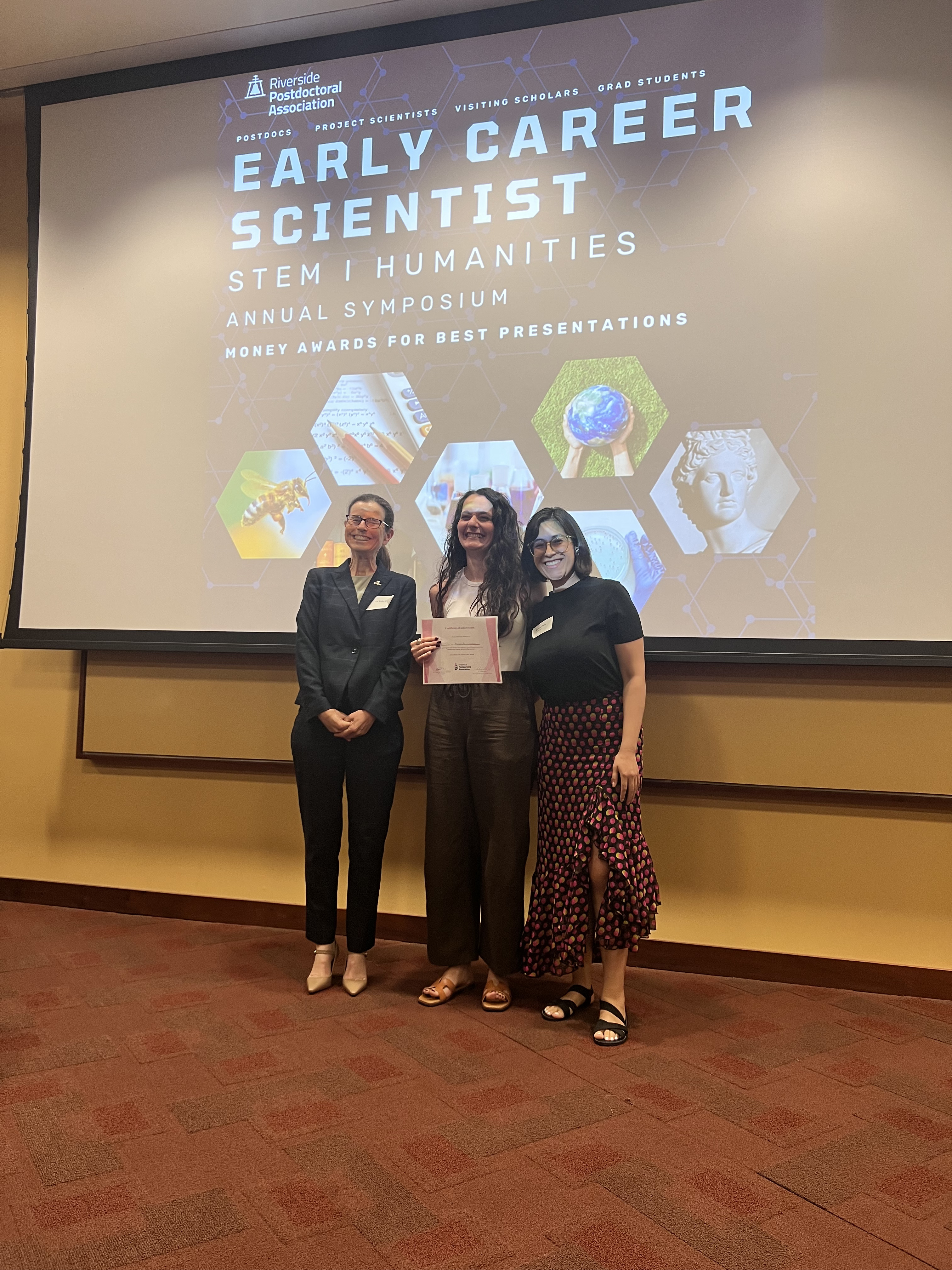
We are delighted to share that our team member María Abizanda Cardona has been awarded First Prize for Oral Presentations at the 2026 Early Career Scientist Symposium, organized by the Postdoctoral Association at the University of California, Riverside.
The symposium brought together researchers from a wide range of disciplines, providing an opportunity for early-career scholars to present their work, exchange ideas, and build new interdisciplinary connections. María’s presentation, titled “Why Scientists Should Read Crime Fiction: Literature as a Laboratory for Scientific Ethics,” explored how literary narratives can serve as valuable tools for reflecting on ethical questions in science and technology.
Her research demonstrates how crime fiction can function as a space for examining complex issues such as scientific responsibility, emerging technologies, and the social consequences of innovation. By bringing together literary studies and scientific ethics, the project highlights the important contributions that the humanities can make to contemporary debates about science and society.
Receiving the symposium’s top award is a significant achievement and a recognition of both the originality and relevance of María’s research. It also reflects the growing importance of interdisciplinary approaches that bridge the humanities, social sciences, and STEM fields.
In addition to presenting her work, María described the symposium as a valuable opportunity to meet fellow researchers, learn about projects across disciplines, and strengthen connections within the academic community.
We warmly congratulate María on this well-deserved recognition and look forward to following the continued development of her research.
In this article, Rubén explores the intersection of Gothic Studies, feminist theory, and posthumanism through a close reading of Kate Zambreno’s novel Drifts (2020). The study investigates how the novel employs Gothic motifs such as haunting, monstrosity, and the uncanny double to challenge conventional representations of pregnancy and motherhood.
Rather than portraying maternity as a stable or idealized experience, Drifts presents it as a process of transformation that unsettles traditional notions of identity, autonomy, and bodily boundaries. Through a posthumanist lens, the novel foregrounds relationality, vulnerability, and interdependence, suggesting that pregnancy fundamentally reshapes the subject’s understanding of selfhood.
The article argues that Gothic aesthetics provide a powerful framework for representing the ambiguities and contradictions of maternal embodiment. By bringing together Gothic and posthumanist perspectives, Rubén demonstrates how Zambreno’s work contributes to contemporary debates on gender, corporeality, and subjectivity.
This publication offers an important contribution to current scholarship on contemporary American literature, motherhood studies, and posthumanist theory.
Congratulations to Rubén on this achievement and on his continued contributions to innovative research in literary and cultural studies.