Welcome to the website of the research projects «The Posthuman Wound: Subject and Agency in the North American Literature of the 21st Century» (PID2022-137627NB-I00. 2023-2026), «Contemporary North American Fiction and the 4th Industrial Revolution: From Posthumanity to Privation and Social Change» (PID2019-106855GB-I00. 2020-2023) and «Trauma, Culture and Posthumanity: The Definition of Being in Contemporary American fiction» (FFI2015-63506-P. 2016-2020).
This year, our team members have prepared a day packed full of events in different Spanish cities.
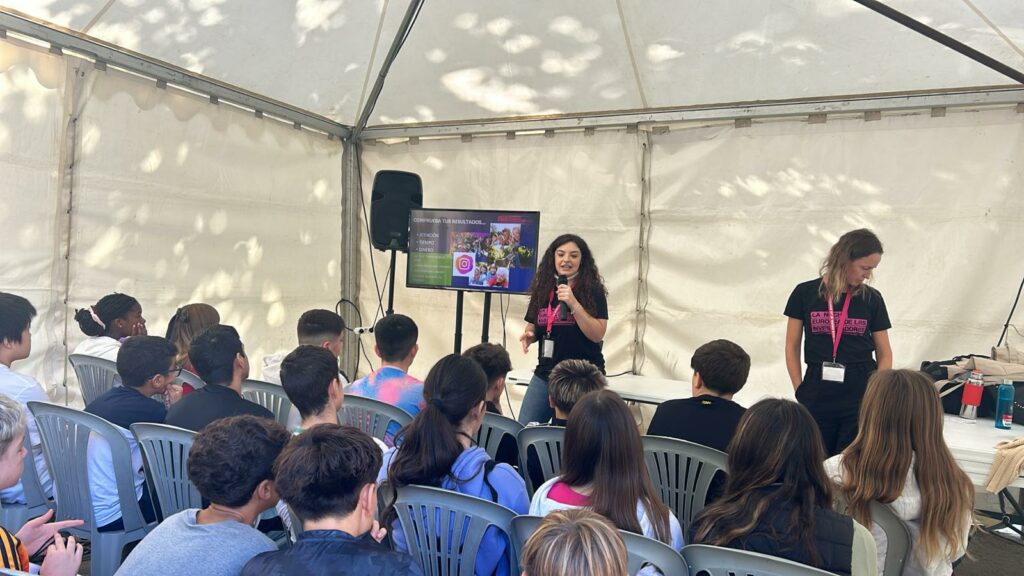
To kick off the morning, Ana Chapman and Marta Martínez-López have delivered the talk “Ser posthumano sin perder la humanidad” to a full house in Granada.
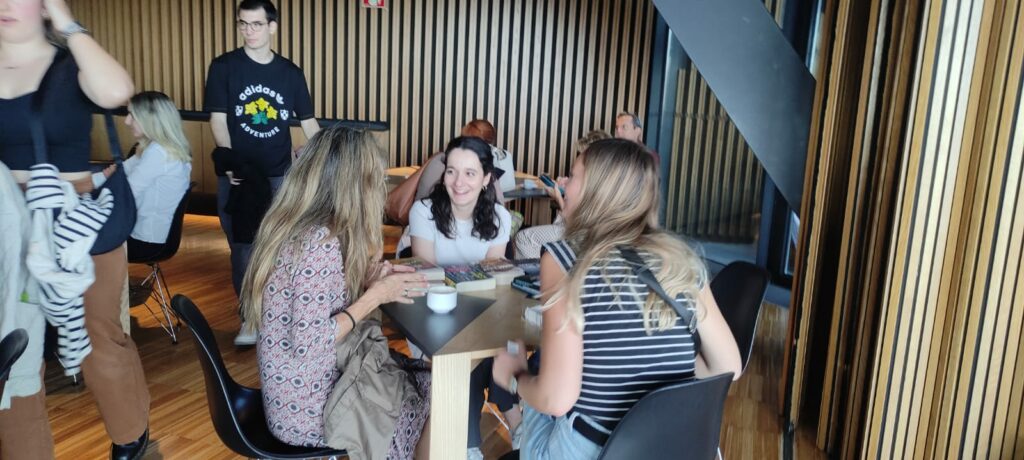
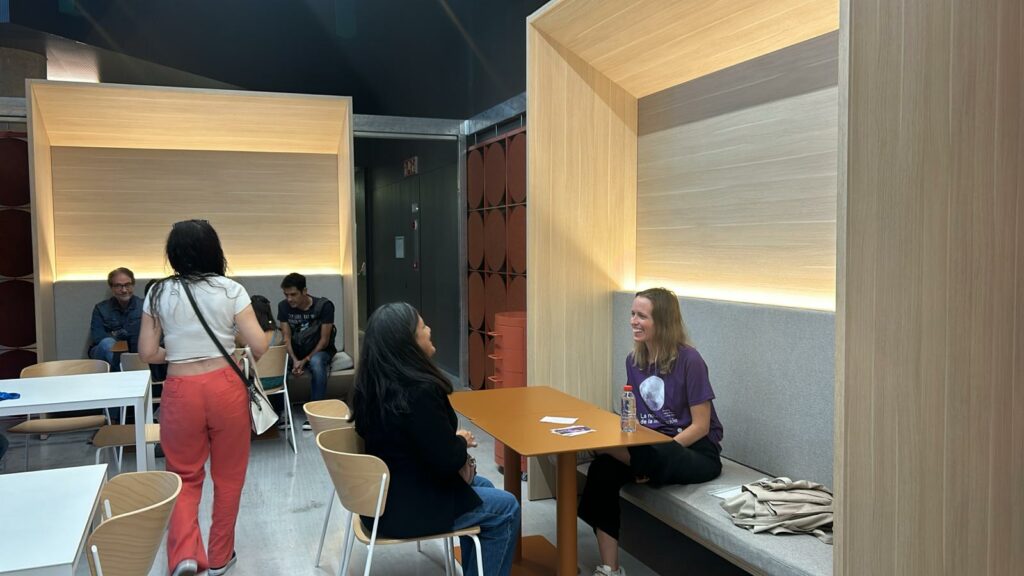
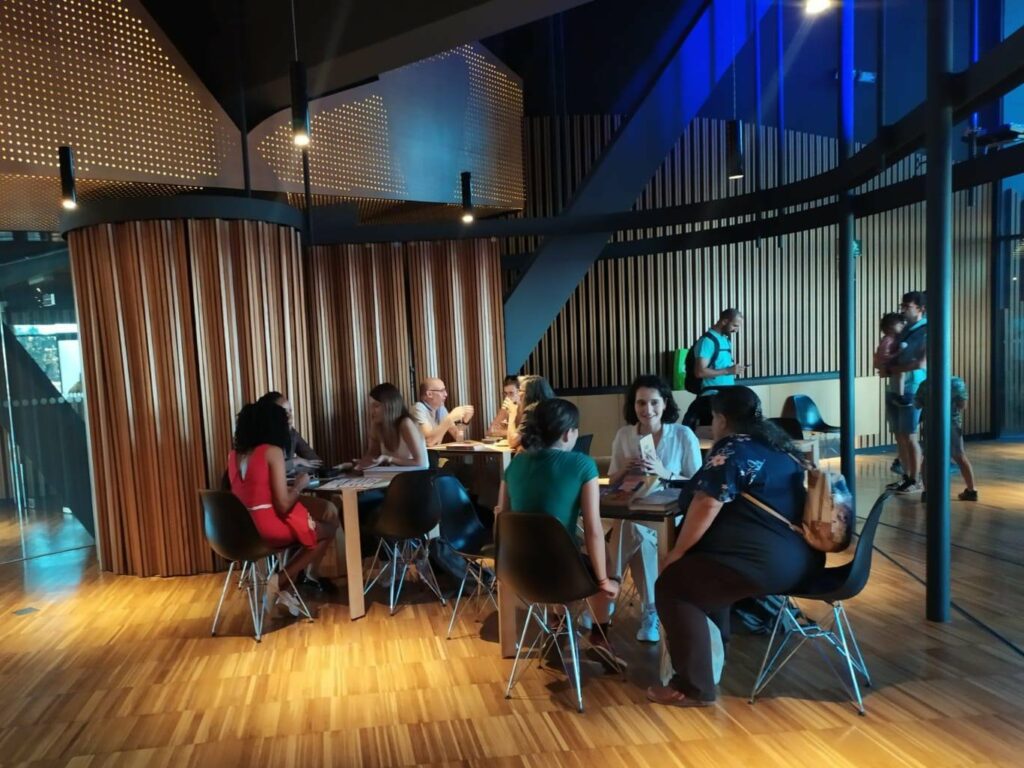
Back in Zaragoza, our predoctoral researcher María Abizanda-Cardona has taken part of the Speed dating event in Caixaforum.
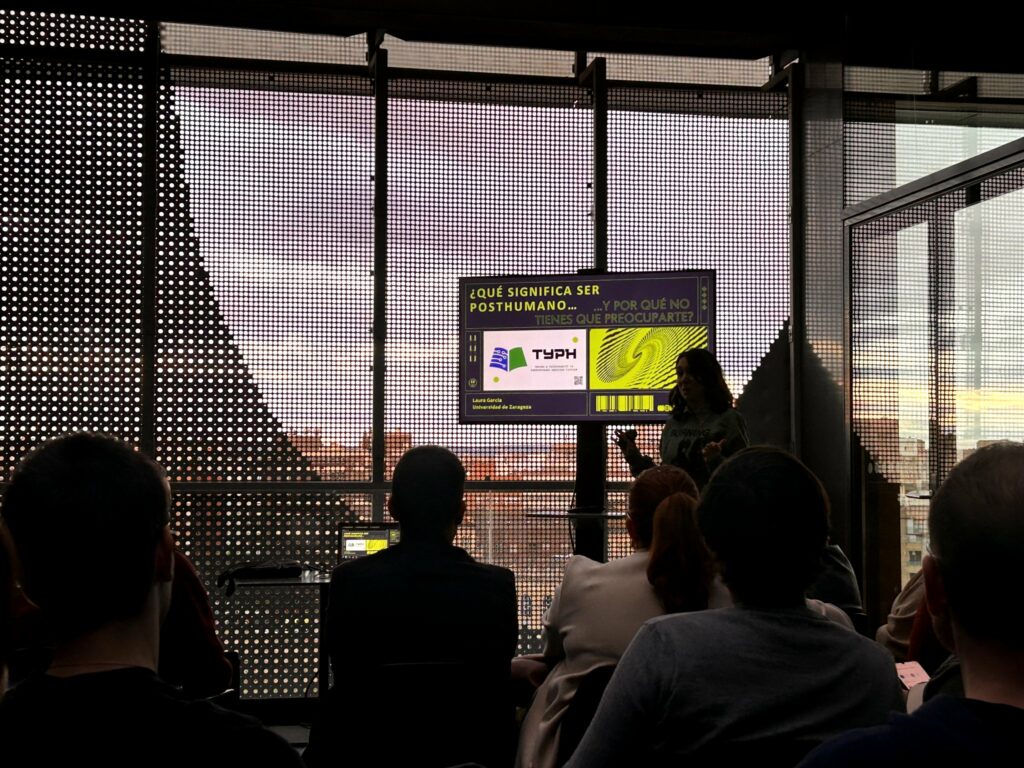
Additionally, our predoctoral researcher Laura García Soria delivered the talk “¿Qué significa ser posthumano… (y por qué no tienes que alarmarte)?”.
Back to Sevilla, Ana Chapman also participated in the speed dating event, chatting about our research with the public.
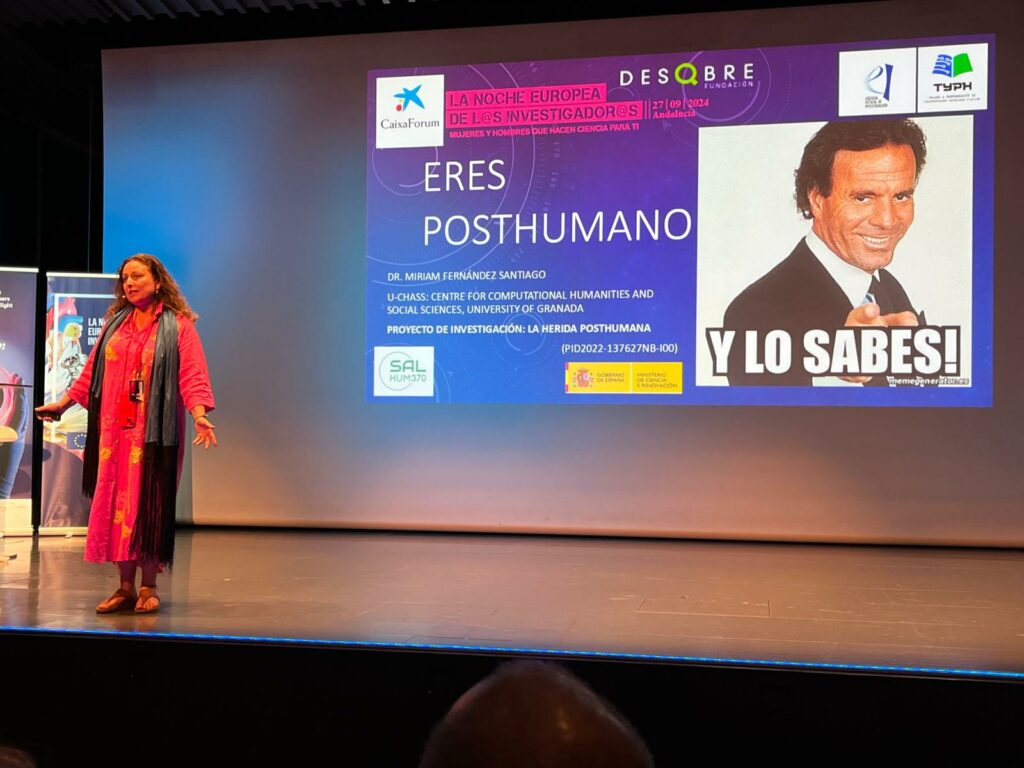
To close off this very busy day with a pinch of humor, Miriam Fernández-Santiago delivered the monologue “Eres Posthumano/a y lo sabes”.
And that’s a wrap on this year’s events for European Researchers’ Night! It’s been a pleasure to chat with the public and share our research in Zaragoza, Granada and Sevilla.
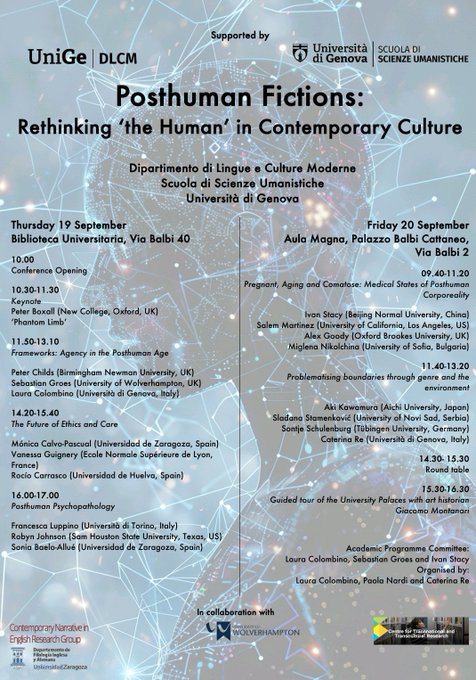
This week, our PIs are taking part of the conference “Posthuman Fictions: Rethinking ‘the Human’ in Contemporary Culture”, celebrated at the Università di Genova.
Our co-PI Sonia Baelo-Allué will deliver the paper “A Narratology of the Posthuman Wound: The Posthuman Trauma Novel in 21st Century US Fiction”.
In turn, Mónica Calvo-Pascual will present the paper “Agency, Ethics and Posthumanity in Rivers Solomon’s Sorrowland”.
12th New Materialisms Conference: Intersectional Materialisms. Diversity in Creative Industries, Methods and Practices
Maynooth University, August 26-28, 2024
Our team members Esther Muñoz-González and Ana Chapman participated in this conference with tw thought-provoking papers. Read their abstracts below:
Esther Muñoz González: “Otherness: Posthuman Discourse and the Queer Body in Pew”
In conjunction with the Enlightenment normative, cognitive, and rational sense of the human, Luciano and Chen distinguish two inflections of the term Posthuman: the affective one, linked to the ability to feel for others, and the understanding of the human as a species, which aligns humans with other forms of life and encourages a material connection, although still maintains hierarchical differences. (2015: 195). The figure of the queer body has repeatedly unsettled the human norm to the point that they have been excluded from the very notion of full humanness (2015: 188). Luciano and Chen favor the term “nonhuman” in the context of queerness, not as an endorsement of nonhuman concepts, but due to its “familiarity, as a common descriptor of the focus of new critical developments” (2015: 196). Catherine Lacey’s third novel, Pew (2020) is set in an unnamed town in the American South, where a church congregation discovers a mysterious figure sleeping on a pew. This person has indistinguishable gender, age, and racial identity. The townspeople grapple with contradictory perceptions of Pew’s identity and disclose their worries and confidences in conversations that are essentially monologues since Pew always remains silent. As the novel progresses, Pew’s presence becomes more and more disturbing for the town community. The purpose of this talk is to analyze the characterization of Pew as a mirror in which the other characters project their fears, combined with the increasing distrust people feel when unable to categorize Pew within a strict label. The analysis traces the intersection of the inherent questioning and revision of the traditional definition of the human being encompassed in Posthuman thought in the story to discuss contemporary fears of otherness linked to concepts such as queer identities, trust, innocence, transparency, and human waste.
Ana Chapman: “Helen Marshall ’s The Migration: The Aesthetics of Nonhuman Metamorphosis, Environmental Entanglements and the Posthuman Wound”
Helen Marshall’s novel, The Migration portrays a near-future apocalyptic world afflicted with global climate change and biological transformations. Floods and an unnerving immunological disease threaten human kind as an individuating biological force. In a non-binary nature-human portrayal, the narrative allows new ways of understanding human “matter” as fluid and embedded in its environment. Barad’s theories on new materialism provide insights into postanthropocentric “more-than-human relationality” observable in the narrative. Moreover, the example of human “matter” being transformed by disease, brings about mental and body trauma to humanity. New organic changes pose questions on relational, transformational and unstable materialism to the human body. With this new metamorphosis of the corporeal, ethical encounters, ontological and epistemological debates (i.e. Barad’s ethico-onto-epistem-ology) are present and hence, human bodies become ground for critical analysis of the anthropocentric, questioning traditional scientific approaches to the body. Drawing on ecocriticism and on authors such as Derrida, Braidotti and Barad, the novel will be examined in its inclusion of human trauma that goes beyond the biological anguish of not being central to evolution (Peters 2020) and in the trauma of human’s core sense of self where nostalgia of recovery has no place. I propose that the wound caused on the novel’s characters becomes the site for dissembling the anthropocentric paradigm and consequently points towards a nonhuman egalitarian system where nature’s embedded and relational modes transcend the boundaries of its biological individual expressions.
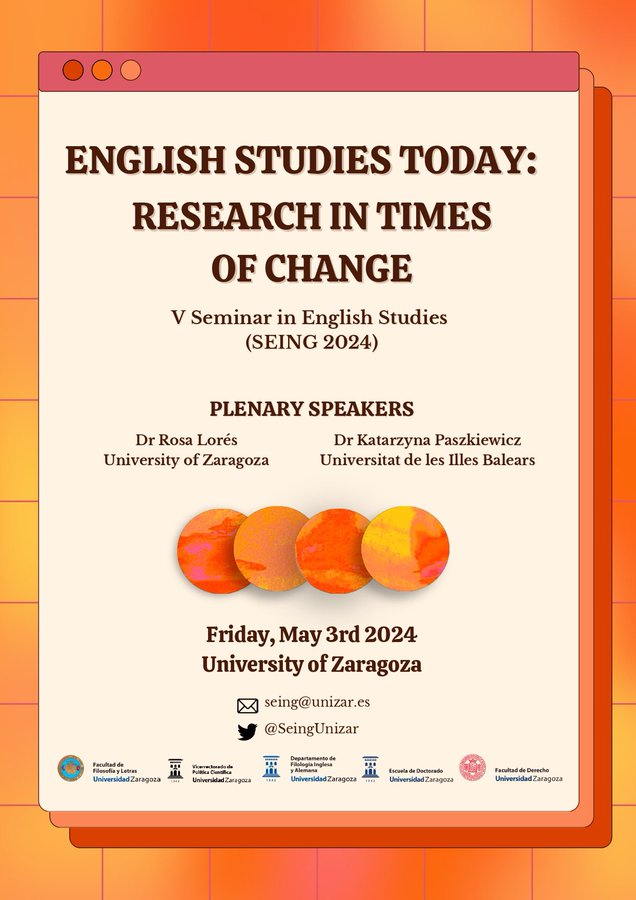
Today the V Seminar in English Studies (SEING 2024) “English Studies Today: Research in Times of Change” is being held by the Doctoral Program in English Studies at the University of Zaragoza.
Three of our predoctoral researchers have delivered their papers on posthumanism and literature in a Panel chaired by our team member Dr. Francisco Collado.
First, our predoctoral student María Abizanda-Cardona has presented her doctoral research in the paper “The Posthuman in American Crime Fiction: A Case Study of Mur Laffery’s Six Wakes (2017)”.
Then, Laura Larrodera-Árcega has delivered the paper “Narrating the Inhuman: Robot Agency in Annalee Newitz’s Autonomous and in Amal El Mohtar and Max Gladstone’s This Is How You Lose the Time War”.
To close the panel, our newly incorporated predoctoral student Laura García has presented her research in the paper “Earth and Humanity in Contemporary Science Fiction: Living, Leaving and Coming Back”.
This week, some of our team members have presented their research in the International Conference of Three Societies on Literature and Science organized by The British Society for Literature and Science, the European Society for Literature, Science and the Arts and CoSciLit in Birmingham.
First, our co-PI Sonia Baelo-Allué introduced the theoretical framework for our research project in the paper “Literature of the Posthuman or Posthuman Literature: The Ethical Dilemmas of Techno-Human Assemblages”.
Connecting online, our predoctoral student María Abizanda-Cardona presented a case study in the paper “Hamlet and (Trans)human (Im)mortality in Em X. Liu’s The Death I Gave Him”.
And to close the panel, Miriam Fernández-Santiago delivered the paper “Diffractive Narration and Posthuman Vulnerabilities: The Digital Motif in Jennifer Egan’s The Candy House”.
This Friday is #EuropeanResearchersNight! Don’t miss our researchers’ contributions to celebrate this special day.
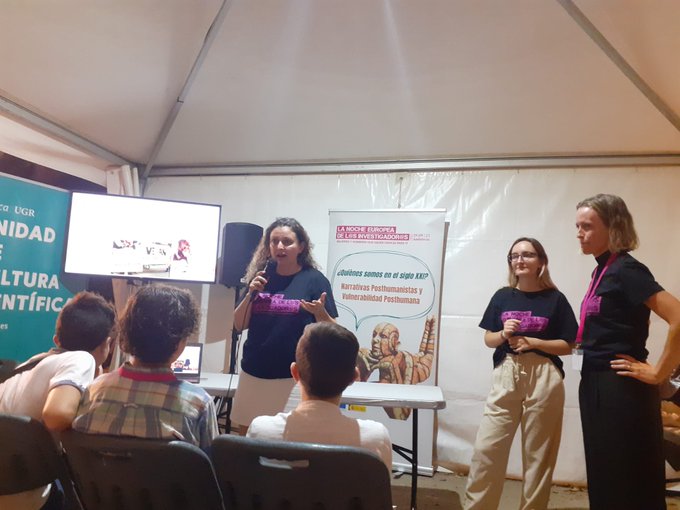
At El Paseo del Salón in Granada, Miriam Fernández-Santiago, Ana Chapman and Lucía Bennet-Ortega delivered the talk “¿Quiénes somos en el siglo XXI? Narrativas posthumanistas y vulnerabilidad posthumana”.
In Zaragoza, María Abizanda-Cardona presented our research at the Speed Dating event of #CaixaForumNocheInvestigación.
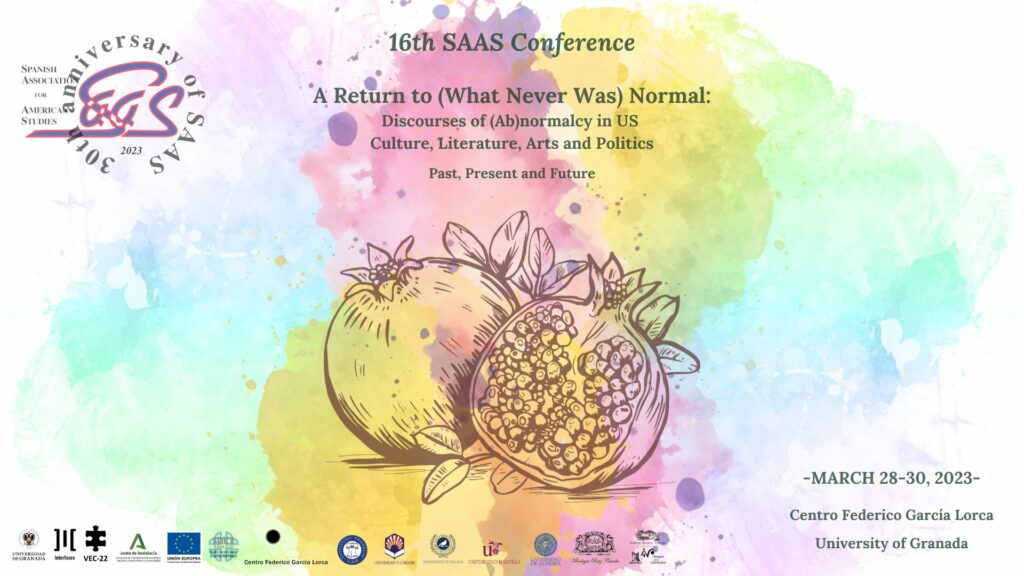
The 16th SAAS Conference has taken place in Granada between the 28th and 30th of March. Take a look at this post to see our team members’ contributions!
Dr. Francisco Collado Rodríguez has inaugurated the panel on posthumanism and the New Normal with a paper on posthuman numbness in Chuck Palahniuk’s Adjustement Day
Dr. Carmen Laguarta Bueno has shared her work on digital surveillance in Dave Eggers’ The Every in the paper “COVID-19 and the Normalization of Digital Surveillance: An Analysis of Dave Egger’s The Every (2021)”.
And to close the first session of the panel, Dr Sonia Baelo Allué has discussed Jennifer Egan’s novel The Candy House in the paper “Digitised Memories and Fragmented Patterns: Constructing and Deconstructing Narrative in Jennifer Egan’s The Candy House”.
The afternoon sessions open with a panel on critical posthumanism and ethics, featuring Dr Mónica Calvo-Pascual’s paper “on material posthumanism in River Solomon’s The Deep”The New Normal: The Inclusive Ethics of Material Posthumanism”.
Our team member Dr María Ferrández-San Miguel has presented her work on Octavia Butler’s trilogy Xenogenesis in the paper “Posthuman (Ab-)Normalcy in Octavia Butler’s Xenogenesis Trilogy”.
And to close the evening, our team’s predoctoral researchers have presented in the second session of Posthumanism and the New Normal. María Abizanda-Cardona has discussed discourses of transhumanism in Lincoln Michel’s The Body Scout in the paper “The American Dream is for American Genes: Challenging the transhumanist New Normal in Lincoln Michel’s The Body Scout”.
And last but not least, Lucía Bennet Ortega has delivered the paper “Posthuman and Entanglements in Richard Powers’ The Overstory”.
On day 2, Dr Rubén Peinado Abarrio has presented his work on the medical subject on Kate Zambrano’s To Write as if Already Dead.
Plus, Dr. Esther Muñoz-González has delivered the paper “Posthuman thought and a Gothic story: Kelly Link’s ‘Two Houses'”.
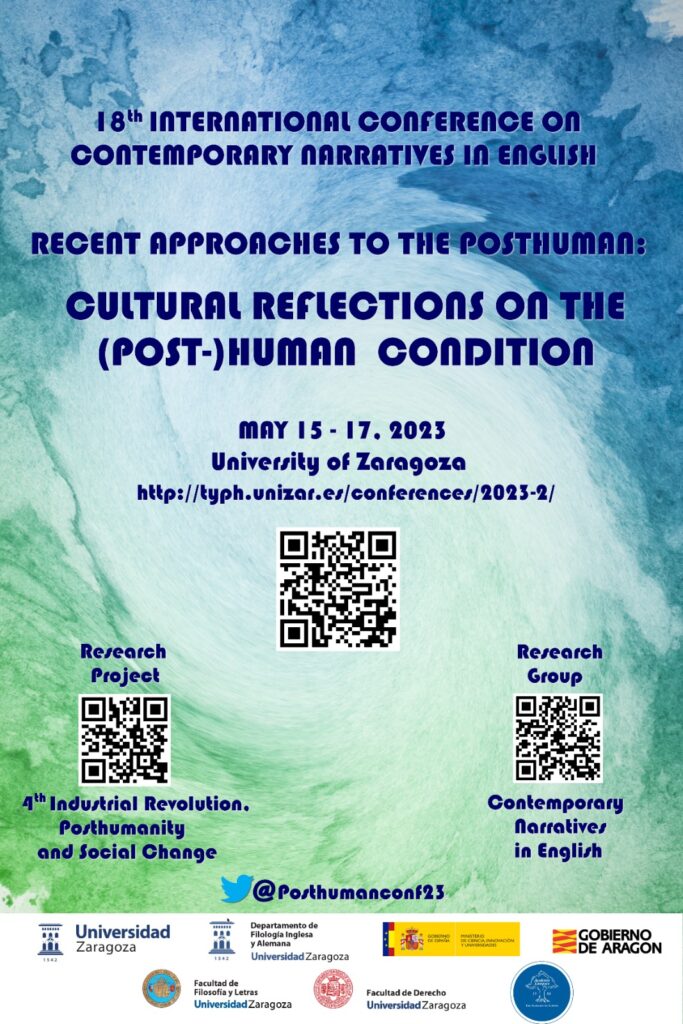
The 18th International Conference on Contemporary Narratives in English “Recent approaches to the posthuman: Cultural reflections on the (post-)human condition” took place at the University of Zaragoza between the 15 and the 17th of May.
Several of our team members have contributed to the conference.
After an amazing plenary by Dr. Sherryl Vint, the first day’s sessions kicked off with the panel “Challenges to the posthuman”
Our team member Francisco Collado-Rodríguez has delivered the paper “The Extension Devours its Maker: McLuhan, the AI’s Wants and the Cyborg -Zombie”.
After lunch, our team member María Abizanda-Cardona shared the starting point of her doctoral research in the paper “Beyond SF: Reading the Posthuman in Crime Fiction”, as part of the session “Posthumanism and genre”.
And to close today’s sessions, our team member Laura Larrodera Arcega presented the paper “Indenture Rights for All: Challenging the Human Status Quo in Annalee Newitz’s Autonomous”. Off to the wine reception!
To start day 2, our co-IP Mónica Calvo-Pascual has delivered the paper “Ethico-onto-epistem-ology and Embodied Memories in Rivers Solomon’s Fiction” in a session revolving around African and Indigenous posthumanism.
Later, our team member Miriam Fernández-Santiago has delivered an engrossing plenary lecture titled “Phenomenal”.
To kick off day 3’s sessions, two of our team members have taken part of the panel “Trauma, memory and the posthuman”. First, Rubén Peinado-Abarrio has delivered the paper “Nomadic Memory in Aleksandar Hemon’s My Parents: An Introduction / This Does not Belong to You”.
Then, our co-PI Sonia Baelo-Allué has discussed the work of Patricia Lockwood in the paper “When Trauma and Posthumanism Meet: Patricia Lockwood’s No One Is Talking About This”.
And that’s a wrap to our conference! We’d like to send the biggest shout-out to our amazing conference organizers María Ferrández-San Miguel, Carmen Laguarta -Bueno and Esther Muñoz-González for their tireless work. And, finally, the biggest thank you goes to all of the speakers for their engrossing contributions, especially to our wonderful plenary speakers. We hope that you’ve enjoyed Zaragoza, and that we’ll meet again soon!
The edited volume Representing Vulnerabilities in Contemporary Literature has just been published by Routledge. Co-edited by our team member Miriam Fernández-Santiago, it includes contributions by Francisco Collado-Rodríguez, Sonia Baelo-Allué and Mónica Calvo-Pascual (“Vulnerability and Risk in Larissa Lai’s Critical Dystopias”), among others.
The Introduction and the chapters by Sonia Baelo-Allué (“Technological vulnerability in the Fourth Industrial Revolution”), Francisco Collado-Rodríguez (“When Immortality Becomes a Burden”), and Mónica Calvo-Pascual (“Vulnerability and Risk in Larissa Lai’s Critical Dystopias”) are available open access here. Read also the abstract and see the full table of contents.